
Australia healthcare Week 2040 EXPO
There is something particular about walking into a conference hall where everyone present has, in one way or another, decided to dedicate their working lives to fixing healthcare. Australian Healthcare Week 2040 at the Sydney ICC was exactly that kind of room — a convergence of clinicians, operators, builders, and investors, all circling the same stubborn problem from different angles. I was there with a small Carelogix booth, and what I expected to be an exercise in brand awareness turned into something far more valuable: a series of genuine, illuminating conversations that have left me thinking long after the event ended.
Beyond the familiar faces I have crossed paths with over the years in the NDIS and aged care space, this year introduced me to a new cohort of founders whose work sits across a surprisingly wide stretch of the healthcare landscape. What struck me was not the diversity of the products on display, but the coherence of the underlying challenge they are all responding to: an industry straining under the weight of its own complexity, with frontline staff caught squarely in the middle.
Check out our advertisement and guideline materials

The Builders in the Room
Some of the most energising conversations came from startup founders who are doing the patient, unglamorous work of rebuilding specific corners of the system from scratch. Let me share a few that stood out.
Practaluma
Full-stack practice management software built specifically for mental health practitioners — a sector often underserved by generic clinical tools. The system is literally removing admin work entirely and is automated allowing the mental healthcare clinician focus on their participants.
Trialio
An AI-powered clinical trials platform helping sites follow up with patients around clinical data. Their prototype is genuinely impressive and it took the team to build this complex prototype in just 7 months and is ready for piloting in clinical trial sites.
Velara
A smarter surgical scheduling system built by Dr Jeremy and his team all the way from New Zealand — the product is as remarkable as the dedication behind it. The cloud-based platform is used to streamline surgical scheduling and it simplifies communication between hospitals, surgeons, and anaesthetists, reducing scheduling errors and last-minute changes.
Kraken Coding
Translating evidence-based clinical guidelines into actionable care pathways at the point of care. Five years in the making — and it shows. Founder John was kind enough to share few tips and tricks when it comes to solo founder and we exchanged few words and encouragement to keep the vision burning. Clinical software is notoriously difficult to get right and the regulatory environment is demanding, the procurement cycles are long, and the tolerance for error in a healthcare context is appropriately low.
RiskConnect
A modular quality management system built on Salesforce, covering root cause analysis, FMEA, fishbone diagrams, and clinical governance frameworks. One conversation I keep returning to is the one I had at the RiskConnect booth. Their approach — building a modular quality system on top of Salesforce — is clever because it sidesteps one of the most persistent barriers to adoption in healthcare technology: the reluctance of organisations to migrate away from entrenched platforms. Rather than asking a health service to abandon what they know, RiskConnect meets them where they are and layers quality management capability on top.
I spent a good while talking through root cause analysis frameworks, failure mode and effects analysis (FMEA), and the utility of fishbone diagrams in clinical governance. These are tools I think about in the context of service delivery at Carelogix — understanding the systemic causes of adverse outcomes rather than reacting to individual incidents. It is exactly the kind of structural thinking that differentiates organisations that improve from those that simply cope.
MIMS
Trusted medication information for clinicians and care workers — a name I know well from my own background in frontline care documentation. Meeting Eloise from MIMS prompted a genuinely useful reflection. MIMS provides medication information to healthcare professionals and frontline staff — the kind of reference material that frontline staff in aged care and disability support rely on to understand what they are administering and why. My mind went immediately to Carelogix, and to how an integration with MIMS could meaningfully improve how our platform supports medication administration for frontline workers in the field.
Staff rarely look at CMIs — those four words surfaced an audit finding that has stayed with me for years, and explains more about digital health adoption than almost any formal research I have read
I used to prepare Consumer Medication Information sheets for frontline staff in my earlier career. The effort that goes into those documents is considerable. But during an audit, a finding emerged that was difficult to argue with: staff rarely look at them. Not because they do not care, and not because the information is poor. They do not look at them because accessing a document — navigating a system, finding the right file, reading through dense clinical language while standing in someone's kitchen before a medication round — is friction that compounds across a shift. When you are responsible for multiple clients, under time pressure, the path of least resistance becomes the default. This is not a failure of staff. It is a failure of design. And it points directly to where technology, used well, has an obligation to step in.
Dolphin Sound Hearing Technology
Kyle from Dolphin Sound was demonstrating something quite specific — hearing amplification technology calibrated around the acoustic properties of small earpieces — but even that conversation circled back to a more universal observation. The people who most need the benefit of good technology are often the least able to navigate the complexity required to access it. That tension is as real in hearing health as it is in disability support, aged care, or clinical trials. Tuning sound waves to power compact hearing amplification devices — thoughtful, precise engineering applied to a deeply personal human need. All came to my mind was just Cochlear - Australia’s leading implantable hearing devices (unsuccessfully applied to them a decade ago to be part of their quality systems team). This startup is about 5 years old, based in Macquarie Park, they require TGA approval for rolling out his product to the Australian Market and apparently the product is already out in the the Chinese Market.
HealthcareLink
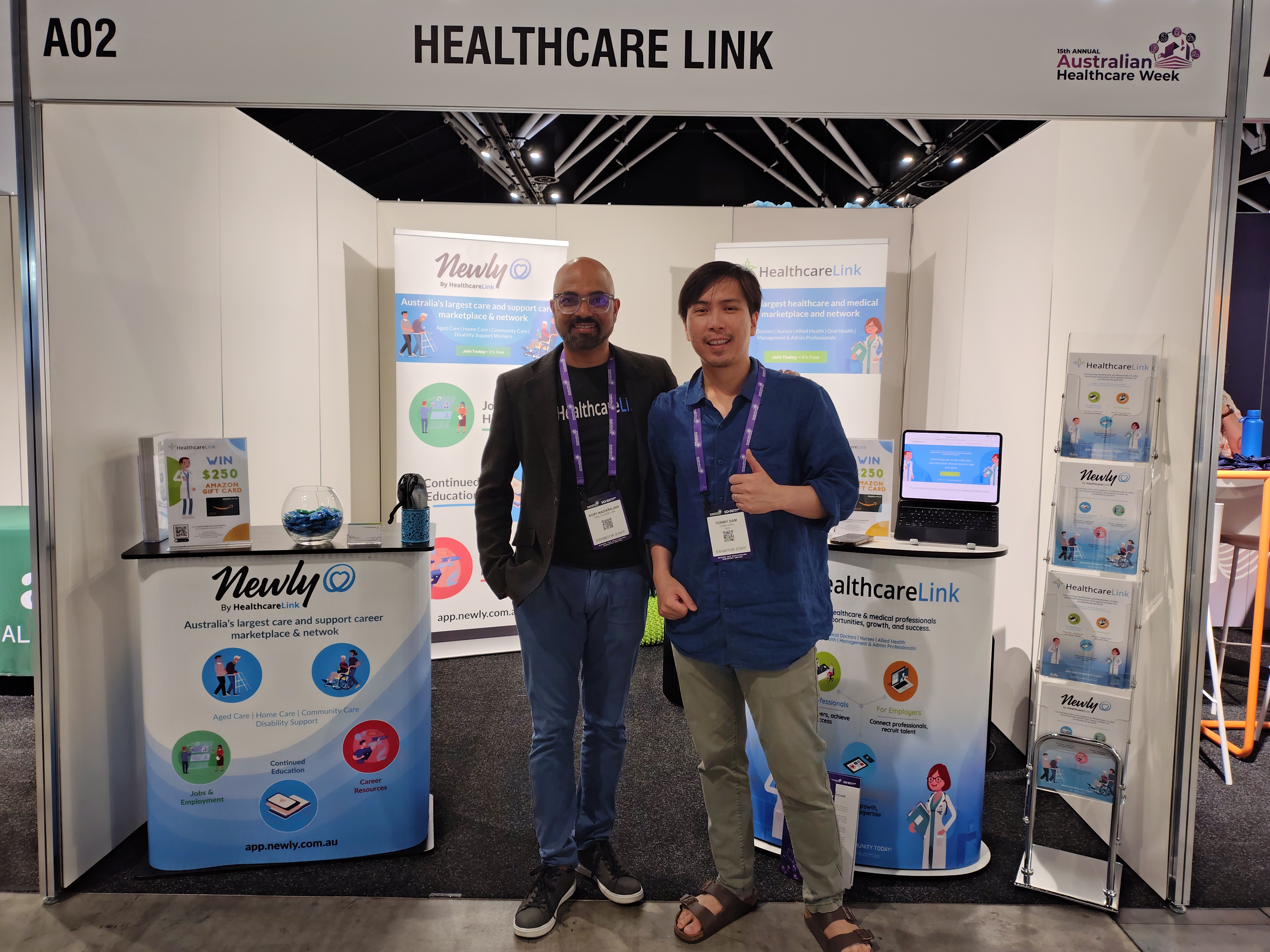
Kopi and his team were also present — always good to see a familiar face in the workforce solutions space, and a reminder of how central staffing and workforce capability is essential to healthcare organisations. HealthcareLink is literally where supply and demand meets for a great outcome to both parties — everyone wins!
The One Theme That Tied Everything Together
Across every conversation at Australian Healthcare Week 2040, one theme surfaced with striking consistency where frontline workers want to do their jobs well, and they will reach for whatever tool most reliably lets them do that. Right now, for many, that tool is paper and pen. Not because they prefer it, but because it works — it requires no login, no connectivity, no training refresh. Any technology aspiring to replace it must earn that trust by being at least as reliable, and meaningfully more capable.
Remote care delivery makes this even more acute. In outer suburban, regional, and rural settings where Carelogix workers operate, connectivity can be patchy, devices can be unfamiliar, and support structures for troubleshooting technology are thin on the ground. The workers managing these environments are not looking for the most feature-rich platform — they are looking for something that does not let them down when they need it most.
AI has a meaningful role to play here, but only if it is applied with a clear understanding of this reality. The opportunity is not to add intelligence on top of existing complexity. It is to use intelligence to strip complexity away — to anticipate what a worker needs before they search for it, to surface the right medication information at the moment of administration rather than making it available somewhere in a document library, to flag a deteriorating client based on aggregated care notes rather than expecting a coordinator to hold that pattern in their head across dozens of clients.
A Panel Worth Listening To
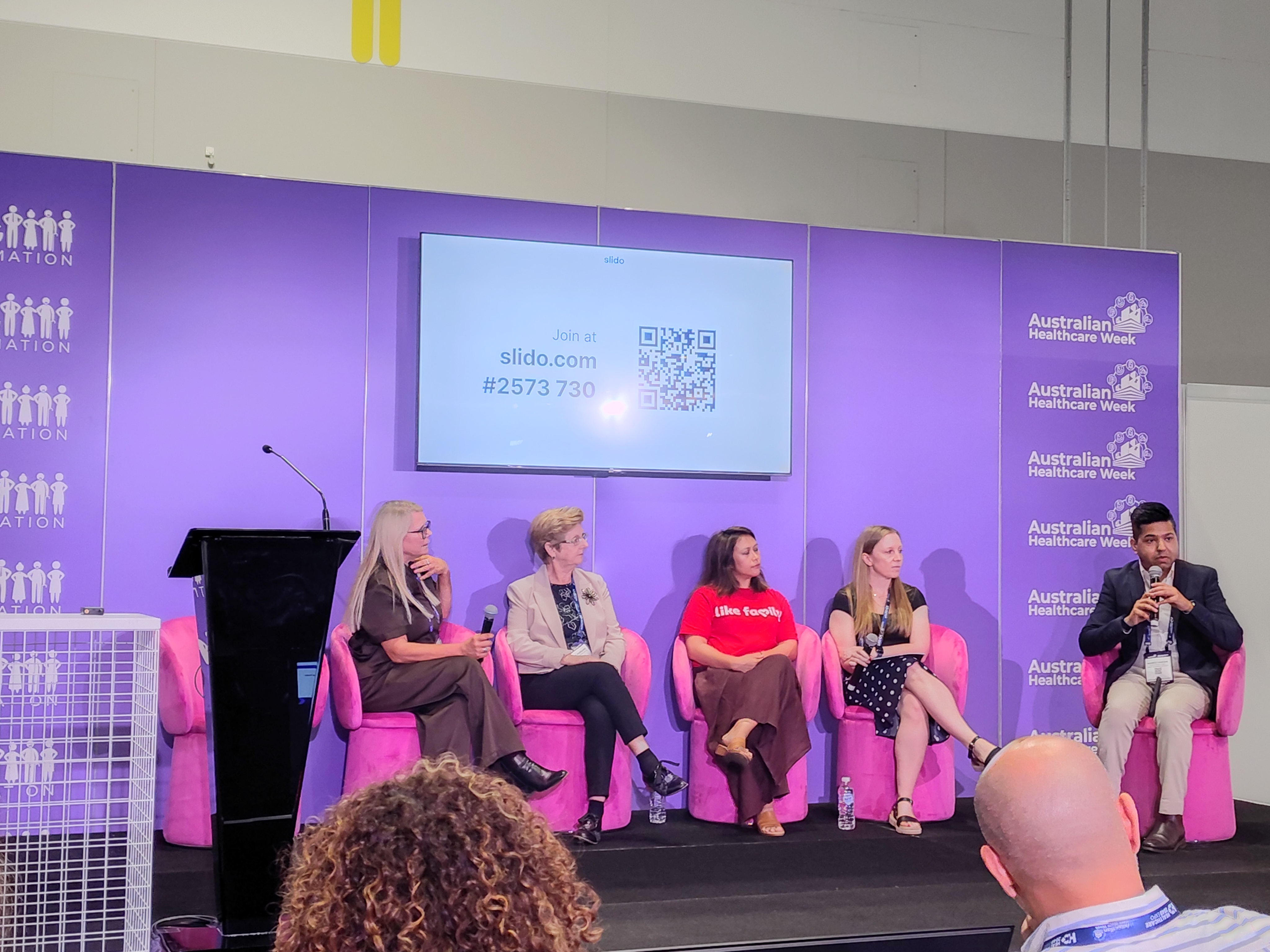
One of the standout sessions of the event was a panel on technology adoption across the aged care workforce, moderated by Rameez Hassan, Chief Nursing Officer at Regis Aged Care. Joining him were Sharon Berridge from Tanunda Lutheran Homes, Wendy-Hubbard CEO of Australian Regional and Remote Community Services, Jenna Leo co-founder of Like Family, and Marissa Dickins, a Senior Research Fellow at Silverchain Group. The conversation was candid, grounded, and at times uncomfortable — in exactly the right way.
A recurring theme was the danger of overcomplicating the technology stack. Sharon noted that her organisation had introduced several overlapping systems early on, ultimately increasing administrative burden rather than reducing it. The lesson drawn was that simplicity and integration are not nice-to-haves — they are prerequisites. As the moderator put it, if a clinician has to navigate two or three separate systems to complete a single documentation task, the implementation has already failed.
Wendy brought a perspective that reframed the entire discussion. Running twelve residential aged care facilities across the Northern Territory, with the majority of residents being First Nations people and staff drawn from Pacific Island, Timorese, Indian, and Nepali backgrounds, her organisation operates in a context where standard assumptions about connectivity, digital literacy, and cultural familiarity with technology simply do not apply. Reliable offline capability is not a feature request — it is a baseline requirement.
Marissa shared research from Silverchain that segmented their workforce into high, moderate, and low digital readiness groups. Two-thirds of staff fell into the moderate category — capable and open, but requiring structured support. The insight was practical: the moderate group is the primary implementation audience, the high group are your champions and co-designers, and the low group needs targeted, patient onboarding.
older clients found AI-assisted interfaces unsettling when they felt too seamless. A small, deliberate amount of friction — walking users through what is happening — built more trust than a frictionless experience that left people wondering how the system knew so much about them
The panel closed on the question of workforce education, with consensus that adaptability and curiosity matter more than any specific technical skill — and that universities have a role to play in building baseline digital health literacy before new graduates reach the sector.
What I am Taking Back to Carelogix
Events like Australian Healthcare Week are valuable for many reasons — the formal sessions, the announcements, the market intelligence. But the most durable value for me is always the informal exchange by standing at a booth next to someone who has been wrestling with a problem for years and finding that your observations align in ways neither of you expected.
The conversations I had over those days have reinforced several things I already believed and challenged a few assumptions I was carrying quietly. I came away with a clearer conviction that the right question for Carelogix is not "how do we give frontline staff more information?" but "how do we ensure that the right information requires the least possible effort to act on?" That reframe matters enormously for how we build.
I also came away with a genuine appreciation for the community of founders working in this space. Building healthcare technology in Australia is hard. The regulatory environment is unforgiving for startups, the funding landscape is challenging, and the clients — whether they are health services, NDIS providers, or aged care operators — have limited tolerance for products that are not battle-tested. The people I met at this event are in it for the long haul, and that is exactly the kind of cohort I want to be building alongside.
To everyone I spoke with across those days — thank you. The conversations were the highlight.
Related Articles

Security Notice 13Aug2026
Company account compromised

Sydney Emergence Feb 2026
The Sydney Emergence 2026 conference spanned three intensive days, bringing together a powerhouse lineup of founders, institutional investors, and family offices.

Live on Apple App Store Jan 2026
Introducing Carelogix Note – Where Care Meets Intelligence