
Community Aged Care Regional Symposium
On 12 May 2026, frontline workers, service providers, policymakers, community leaders, and teachers from four regions of New South Wales came together for a landmark symposium on place-based community aged care. Hosted simultaneously across Parramatta, Marrickville, Wollongong and Gosford, the event was convened by a network of four regional social development agencies: Western Sydney Community Forum, Inner Sydney Voice, Community Industry Group (representing the Illawarra and southern NSW), and Central Coast Community Council. What unfolded over the course of the day was a rich, honest and at times deeply moving exploration of what it means to age in community, the profound pressures facing the aged care sector, and the practical steps regions are already taking to deliver better outcomes for older Australians.
This blog captures the key insights, challenges and calls to action that emerged from the day. It is written for everyone who was in the room and for those who could not be, because the conversation that began here must not end here.
Setting the Scene
The timing of the symposium could not have been more significant. It fell on the day of a federal budget announcement, two days before the Australian National Audit Office was due to submit its report to the federal government on the effectiveness of the transition of the Commonwealth Home Support Programme (CHSP), and amid a newly announced parliamentary inquiry into aged care with submissions due in July. In short, aged care policy is in a state of active flux and the decisions being made right now will shape the lives of millions of older Australians for decades to come.
The forum's conveners were deliberate in framing the event not just as a sector briefing but as a mechanism for building collective advocacy. As Western Sydney Community Forum CEO Billie Sankovic observed, the four regional agencies together represent more than six million people across their respective footprints. The event is a powerful platform for influencing the policy decisions that are made at Macquarie Street and in Canberra, decisions that affect communities as different from one another as Bankstown and Picton, Merimbula and Wollongong, Gosford and Marrickville. Marika Kontellis, Chief Executive Officer, Inner Sydney Voice Facilitator, kick-started the event with warmly welcoming the audience followed by the acknowledgment of country.
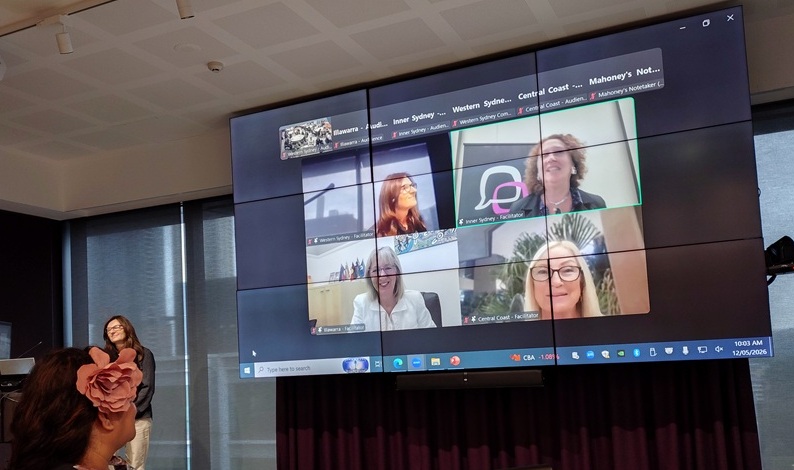
On the screen from top left is Billie Sankovic, top right is Marika Kontellis, bottom left is Nicky Sloan and bottom right is Dr Penny Newson.
Across the day, participants heard from keynote speaker Jean Kittson, a panel of regional aged care leaders, working groups from each location, and a representative from the NSW Government. The thread connecting every session was the same: aged care is everyone's business, the system is under enormous strain, and the solutions lie in collaboration, place-based knowledge, and the courage to speak clearly about what is and is not working.
A Voice From Lived Experience
Perhaps the most memorable contribution of the day came not from a policy expert but from a writer, comedian and carer. Jean Kittson, author and ambassador for Macular Disease Foundation Australia, spoke candidly about her twenty years as the primary carer for her parents, who passed away two years ago. Her mother was ninety-nine, her father ninety-six. Both lived independently in their own home until the final four weeks of their lives.
Kittson was careful to reframe what being a primary carer actually meant in practice. By the end, she was not doing the daily physical care herself. She was leading a team of approximately twenty people. The coordination required to maintain that level of support was, in her words, intricate, sophisticated, frustrating, and hair-raising. She navigated assessment systems, fought for her parents' rights and dignity in medical rooms, banks and shops, and grappled with a bureaucracy that often seemed designed for an idealised client rather than real people with hearing impairment, vision loss and the ordinary complexities of ageing.
Her experience of the assessment system was illustrative of wider systemic problems. She described calling to register her parents for aged care support and being told she had to leave the room while the assessor spoke to her parents directly, even though her father could not hear the assessor and her mother could not read her pension number aloud. These were not exceptional circumstances. They were, as Kittson reflected, representative of a system built around compliance rather than around people.
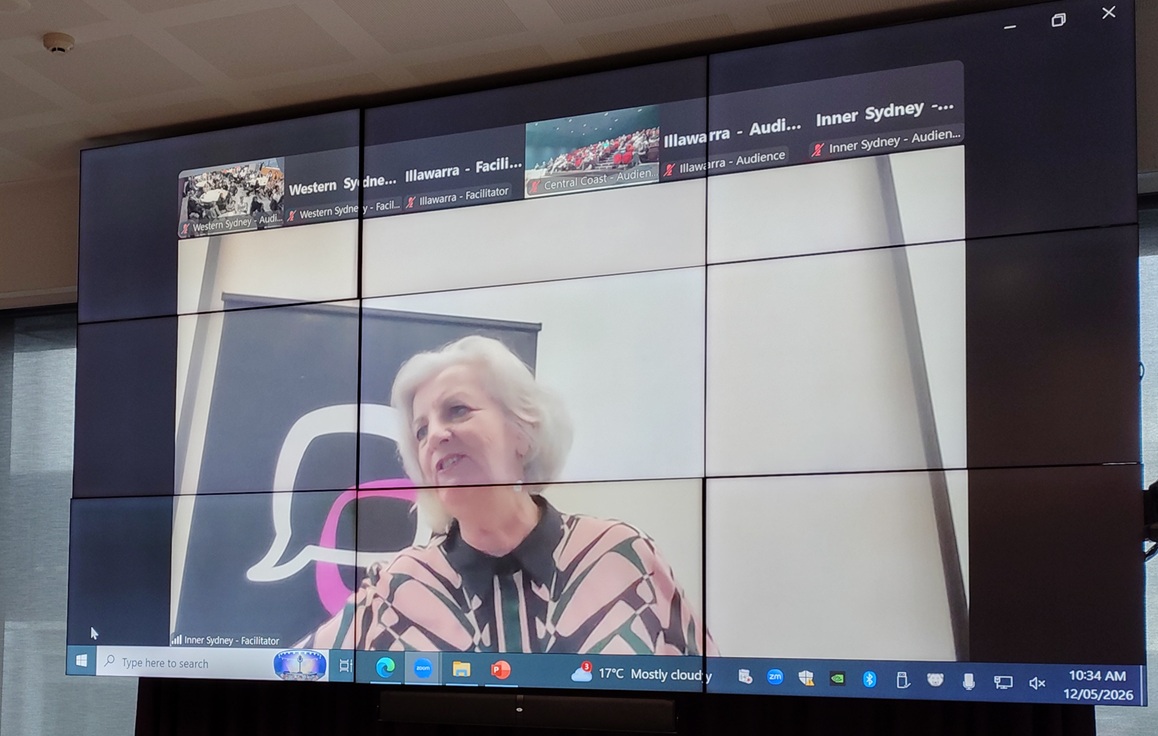
Jean Kittson on the big screen speaking to the audience
You cannot separate personal care from clinical care.
Kittson also noted the shift from four assessment levels to eight under the new support-at-home framework, and her observations aligned with what practitioners across the room were experiencing. Every provider she had spoken to reported that there were not enough assessors to manage eight levels, that the system required reassessment at each level, and that the division of clinical care from personal care was fundamentally at odds with how holistic wellbeing actually works. You cannot be well, she said plainly, if you have not had a shower. You cannot separate personal care from clinical care.
When it actually happened... I couldn’t access palliative care; I couldn’t access the support that Mum and Dad needed—it was all a big mess
One of Kittson's key observations is how complex navigating the aged care system can be. Despite being an ambassador for Palliative Care Nurses Australia and writing extensively about ageing in her books—such as one titled Parenting Our Ageing Parents—she still struggled with accessing adequate support during critical moments in her parents' lives. “When it actually happened... I couldn’t access palliative care; I couldn’t access the support that Mum and Dad needed—it was all a big mess”. This sentiment underscores how even those familiar with healthcare systems can find themselves overwhelmed by bureaucracy.
They’re not a burden economically; they’re not a burden psychologically; they’re not a burden emotionally… They are people who have added their thoughts and deeds to our community’s fabric
The challenges extended beyond logistical hurdles; emotional struggles were also profound. Reflecting on societal attitudes towards older people, Kittson questioned why elders are often viewed as burdens rather than valued members of society who have contributed significantly throughout their lives “They’re not a burden economically; they’re not a burden psychologically; they’re not a burden emotionally… They are people who have added their thoughts and deeds to our community’s fabric” .
Beneath these systemic observations, however, was something more fundamental. Kittson spoke about the moment she was asked by a panel facilitator what had most surprised her about caring for ageing parents. She found herself unable to answer, overwhelmed by images of her parents' vulnerability and the countless times she had needed to stand up for their dignity. In shops, in hospitals, in their own beds, their rights as full human beings had to be actively defended. That experience, she said, gave her the deepest understanding of why language matters. Our elders are not the elderly. Elderly is an adjective. Our elders are people, and treating them with the same full respect and autonomy we would extend to any adult is not a courtesy but a responsibility.
Kittson spoke about the intergenerational dimension of care with equal conviction. The relationship between her parents and their grandchildren was, she discovered at their funerals, profoundly significant in ways she had not fully appreciated while they were alive. The grandchildren spoke of how their grandparents had made them feel safe, confident and seen. That is not incidental to wellbeing. It is central to it. A society that separates its generations, that treats its elders as a burden rather than as repositories of wisdom and lived experience, impoverishes itself.
She is now writing a second book focused on end-of-life care, palliative support, and the practical realities of dying well, drawing on her experience that even when you know what good palliative care looks like in theory, actually accessing it in practice can be another matter entirely. She described a postcode lottery in palliative care and committed to taking her observations directly to government, not as criticism but as contribution. It is not us and them, she said. We all have to work it out together.
The Regional Peaks
Following Kittson's address, the four regional social development agencies explained the model underpinning the symposium itself. Understanding this model is important because it shapes the kind of advocacy that is possible.
Each of the four agencies is a regional peak. They are place-based, meaning they have deep, long-standing knowledge of their specific geographies and communities. They are independent of service delivery, which means they are not competing for clients or contracts. Their role is to work across the service system, support sector capability, and represent the voices of frontline workers and communities to decision makers. They are, as one participant described them, the conduit between people with lived experience, service providers, and the policy tables where decisions are made.
What makes the current network significant is that the four agencies are acting collectively. Individually, each has deep place-based credibility. Together, they represent a substantial and diverse cross-section of New South Wales. The regions are not homogeneous. Western Sydney encompasses everything from dense multicultural suburbs to newly developing outer areas with minimal social infrastructure. The Illawarra and southern NSW covers 55,000 square kilometres, an area larger than several European countries. The Central Coast has both coastal and rural hinterland communities. Inner and eastern Sydney contains some of the most densely populated and diverse urban environments in the country alongside some of its most socially isolated individuals.
When these regions speak with one voice about a shared challenge, that voice carries weight. And when they speak about the ways in which that shared challenge manifests differently across different geographies and communities, they provide decision makers with the nuanced, place-based intelligence that is so often missing from centralised policy development.
The agencies operate, it should be noted, without dedicated government funding for the network itself. They have built this collaboration through relationships, commitment and a long-standing culture of mutual support. That in itself is a testament to the value of place-based social development as a model.
What Aged Care Regional Panel Looks Like on the Ground
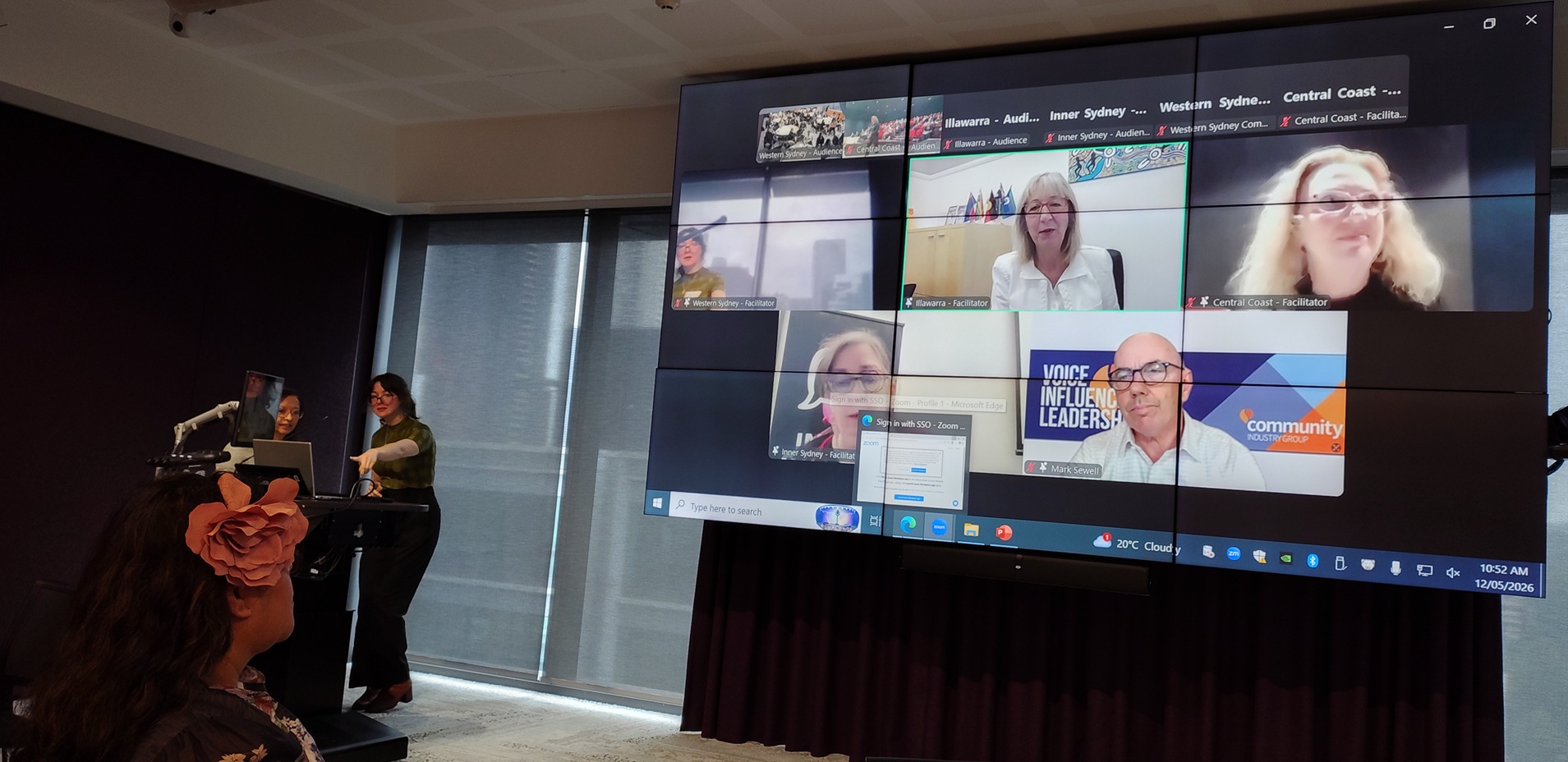
The centrepiece of the morning was a panel of four regional leaders, each painting a picture of aged care in their area. Their accounts were candid and detailed and, while each region had its own character, the structural challenges they described were strikingly consistent.
Juana Reinoso, CEO of CORE Community Services in western Sydney, described a region defined by extraordinary cultural diversity. More than 46 percent of western Sydney's population speaks a language other than English at home. There are more than 100 languages spoken across the region. For aged care providers, this creates a layer of complexity that the current system is largely not designed to accommodate. The new support-at-home framework, with its increasing emphasis on accountability and administration, leaves little room for the kind of community engagement and cultural education that is essential before a CALD client can meaningfully navigate the aged care system. Block funding, Reinoso noted, gave providers the flexibility to invest in clients according to their needs at a given moment in time. The current fee-for-service model does not.
Her organisation works hard to match workers to clients by language and cultural background, and she described this as one of the things working well. When families understand the system, when they are treated as partners rather than obstacles, care outcomes improve. But achieving that requires investment, and that investment is increasingly hard to justify within the parameters of current funding structures.
Janet Green, CEO of Junction Neighbourhood Centre in inner and eastern Sydney, drew a different but equally complex picture. In the inner city, the challenge is not intergenerational households but rather their absence. Many older people in the region have lived there for decades, but their children and grandchildren have moved away, usually due to housing affordability pressures. What remains is a significant population of older people with no immediate family nearby, living in dense but socially isolating environments, often in social housing.
Green pointed out that in one suburb alone, more than 100 aged care providers offer individual social support services. This abundance of providers does not translate into clarity of choice for older people. It creates confusion, fragmentation and a competitive dynamic that works against the kind of coordinated, place-based care that genuinely improves lives. She also raised the phenomenon of people who had transitioned from home care packages to the new support-at-home programme but now cannot afford the co-contributions and are seeking to return to CHSP. This is not a marginal problem. It is a signal that the reform has created new barriers to access for some of the most vulnerable older people in the system.
Green's organisation has been part of a research project on social isolation involving five inner-city agencies, and out of that work has emerged the Sydney Community Collaborative, a new structure for turning research insights into practical action. She also noted the value of Healthy Ageing Hubs, funded by the Primary Health Network, as a model for linking aged care navigation with broader positive ageing initiatives in local communities.
Mark Sewell, drawing on his experience as former CEO of Warrigal and his current work with Wesley Mission, Ageing Australia and Pacific Health in the Illawarra, represented a region that in many ways exemplifies the geographic and workforce challenges facing aged care outside metropolitan centres. The Illawarra and southern NSW region covers 55,000 square kilometres and 12 local government areas, served by more than 100 aged care organisations ranging from very large providers to very small community-based ones. The population is growing, particularly among older people who retire to coastal towns, but services cannot keep pace. Nearly half of all people who receive an aged care approval in the region cannot access the services they have been approved for.
Sewell described three initiatives of particular significance. The first is a major research project examining the experiences of older people who are stuck in hospital rather than receiving community aged care, tracking how long they stay, how many hospitals they move through, and what their fears and circumstances are. The second extends this data set to more than 21,000 people with home care aged care approvals. The third is a STARS volunteer programme that visits people stranded in hospital, hears their stories, and helps them navigate back into community-based care. Together, these data sets have enabled the formation of a regional task force bringing together federal and state politicians, the Department of Health and Ageing, state health, local government, the University of Wollongong and the Primary Health Network. The task force is examining the data collectively and asking what each stakeholder can do differently. It is rare and powerful, and it exists because of the strength of regional relationships built over many years.
Fiona Morrison, ALICE Community Engagement Officer, from the Health, Quality, Strategy and Improvement Unit at Central Coast Local Health District, described a region with a rapidly ageing population, significant cultural diversity across around 44 languages, and a large and growing First Nations community. The Central Coast has both urban coastal areas and a rural hinterland, and the challenges of delivering equitable services across this geography are considerable. More than 50 percent of all hospital admissions involve people over 70, who occupy 56 percent of acute care beds. The pressure on the health system is directly linked to the adequacy of community aged care, and the inadequacy of that care is visible in hospitals every day.
Morrison described her work on health connection kiosks, a pilot model co-designed with older people themselves that takes services into local communities rather than expecting people to travel. This kind of place-based thinking, developed in partnership with the people it is meant to serve, is precisely what is needed but rarely funded at scale. She also spoke about the importance of community transport as a connector for people in more isolated areas, and about the central role of carers, particularly spousal carers, in navigating the aged care system on behalf of the people they love.
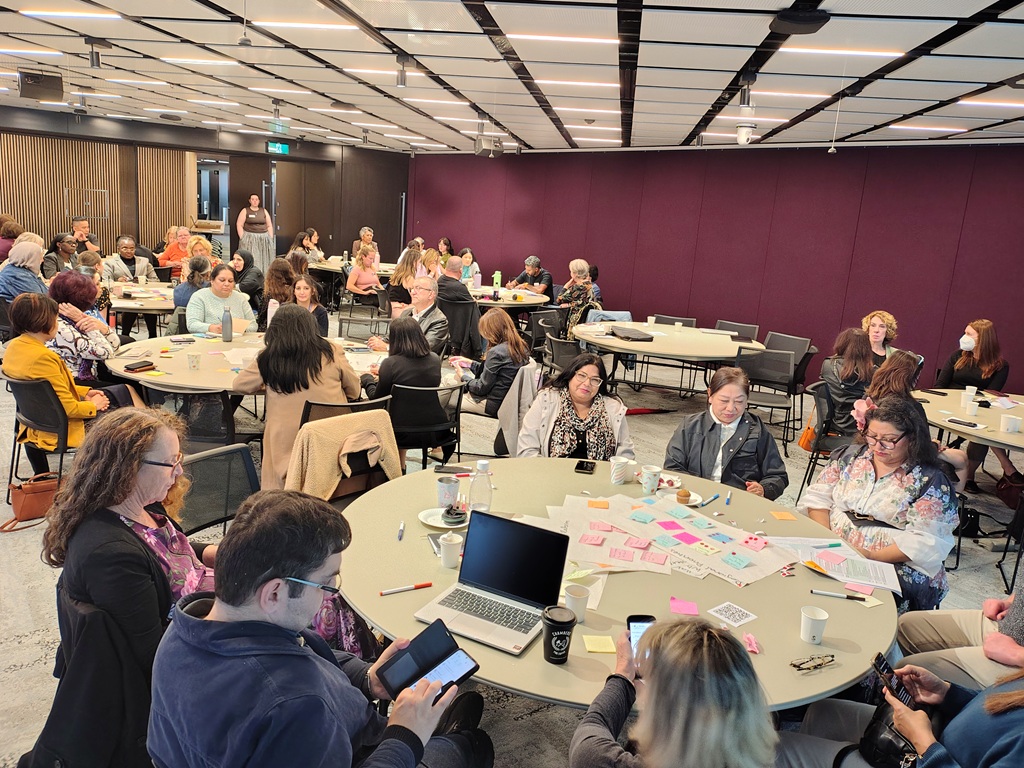
My table was filled with inspirational Teachers from TAFE that provided qualification in Aged Care Cert III/IV designed for frontline workers in Australia.
What the Afternoon Conversations Revealed
Working groups across all four regions spent time in the afternoon identifying shared challenges and priorities. When their findings were reported back, the consistency was striking.
The complexity and opacity of the current system came through as a dominant theme everywhere. Providers and clients alike are struggling to understand and navigate the reforms. The information they receive is inconsistent, sometimes contradictory, and frequently unclear. This is not simply a communication problem. It reflects a system in which the policy framework has not been fully worked through before implementation began, and in which the distance between Canberra and a coastal community in southern NSW can feel very large indeed.
Workforce was identified as a critical pressure point in every region. The challenge is not only one of numbers but of conditions. In high-cost areas, workers travel long distances to deliver care. In regional and rural areas, there are simply not enough workers of any kind, and the transition from manufacturing and industrial employment toward community services requires deliberate investment in training and development that is not currently happening at the scale required.
Waiting lists for support-at-home were identified as a significant and worsening problem, particularly in communities with high levels of vulnerability or socioeconomic disadvantage. Co-contributions are deterring people who genuinely need care from accessing it. The CHSP is absorbing people who are waiting for packages they have been approved for, sometimes for more than a year, which creates pressure on CHSP providers and distorts what the programme is designed to do.
The loss of flexibility under the new funding model was felt acutely. The shift from block funding to fee-for-service has removed the ability of providers to invest in clients on a longer-term basis, to tailor services to changing needs, and to do the relationship-building work that makes everything else possible. Care is increasingly being delivered according to what is fundable rather than what is needed.
Social isolation, the inadequacy of social infrastructure beyond formal aged care, the need for allied health and GP access in regional areas, and the importance of intergenerational connection were all raised across multiple groups. These are not add-ons to aged care. They are foundational to the wellbeing of older people and to the sustainability of the formal care system.
The NSW Government's Perspective
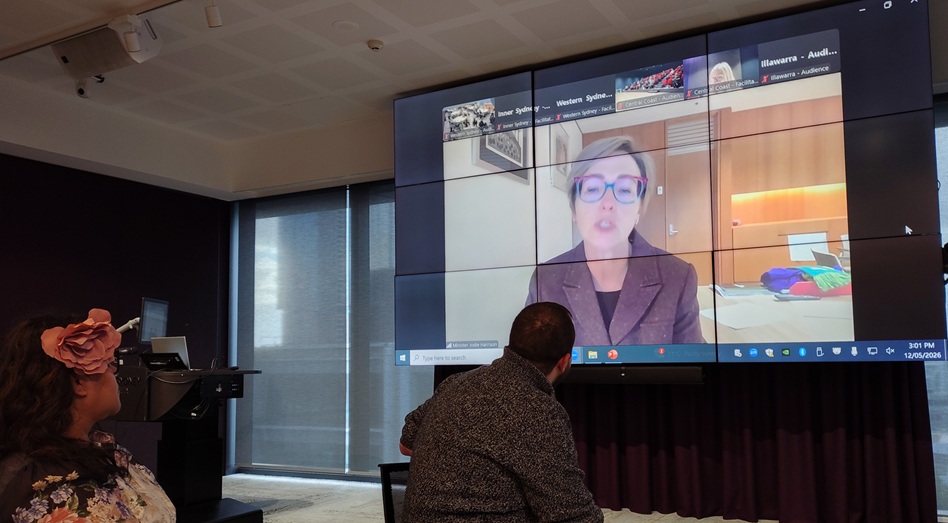
The Hon Jodie Harrison MP, Minister for Women, Minister for Seniors, and Minister for the Prevention of Domestic Violence and Sexual Assault Minister, from the NSW Government addressed the symposium in the afternoon, acknowledging the forum's importance and affirming the government's commitment to helping older people age with dignity, remain connected to their communities, and access the right support at the right time. The government's Ageing Well in New South Wales strategy was described as a whole-of-government commitment to support older people to remain active, connected and independent.
As our population lives longer and we’re leading more diverse lives—which is a wonderful thing—the task before us though is very clear... every older person in New South Wales can and should age with dignity and remain connected to their communities
The government representative acknowledged the shared responsibility between the NSW Government, the Commonwealth, service providers and communities, and expressed genuine interest in the evidence-based and practice-grounded proposals that the symposium would generate. She noted specifically the value of organisations like Inner Sydney Voice as a bridge between government and service providers, and expressed support for prevention, early intervention and system integration as the priorities most likely to produce sustainable outcomes. “As our population lives longer and we’re leading more diverse lives—which is a wonderful thing—the task before us though is very clear... every older person in New South Wales can and should age with dignity and remain connected to their communities.” This statement underscores her commitment to ensuring that ageing Australians not only live longer but also enjoy quality of life within supportive environments.
That framing resonated with much of what had been heard throughout the day. Prevention and early intervention are exactly what place-based CHSP and community support programmes deliver, and they do so at a fraction of the cost of hospital admissions or residential aged care. The economic case for investing in community aged care is clear. The challenge is ensuring that the funding mechanisms, the workforce, and the policy frameworks are aligned to make that investment effective.
The symposium itself was presented as an opportunity for stakeholders from various regions to come together. According to Harrison “The symposium that you’re part of today is obviously your chance…to identify opportunities to strengthen collaboration between all the different sectors that work in this space.” This collaborative spirit reflects her belief that addressing systemic issues requires collective action from governments at all levels alongside community organisations.
Moreover, Harrison stressed prevention-focused strategies as key priorities moving forward “Local proposals…will be aligned with what are my priorities of prevention and early intervention and system integration.” She acknowledged these measures take effort but noted their potential long-term benefits as genuine collaboration takes time. This vision highlights both immediate actions required—such as expanding coordinated supports—and long-term goals centred around sustainability. As policymakers like Jodie Harrison continue advocating inclusive frameworks grounded firmly within evidence-based practices combined alongside grassroots input , there remains hope brighter days ahead Australian elders families alike .
Genuine collaboration takes time
What Comes Next
The closing remarks of the day were characterised by gratitude, clarity and genuine determination. Participants were reminded that the shared challenges identified across four very different regions are not coincidental. They reflect structural features of a national system, and the only way to change structural features is through collective, sustained, evidence-based advocacy.
The practical call to action was straightforward. Take the insights from today back to your teams. Bring them into your planning and decision making. Do not let the conversation end at the door. Reach out to others in the sector and continue the relationships started here. Document what you are seeing, both the challenges and the successes. Capture case studies and data that can feed into collective advocacy. Use the regional peaks and the network they represent as the vehicle for that advocacy, because that is precisely what the network exists to do.
There is also a specific and urgent task ahead in terms of the policy processes currently underway. The parliamentary inquiry into aged care has submissions due in July. The findings of the Australian National Audit Office report on the CHSP transition will need a response. The federal budget may create new opportunities or new pressures. These are not abstract processes. They are the moments at which the voices heard in this room can be translated into policy influence. The four regional agencies are committed to making that translation happen, but they need the sector to speak clearly and consistently about what it is experiencing.
Jean Kittson perhaps said it most memorably. She spoke of the aged care system as something that belongs to all of us, not as a specialised concern for professionals and bureaucrats but as the fabric within which every family eventually finds itself. Her parents were not unusual people. They were people. People who needed others to stand up for their dignity, to advocate for their rights, to treat them as full human beings with their own voices and their own autonomy. That is the work that every person in the room on 12 May 2026 is doing, and it is work that matters profoundly.
Aged care ranked thirteenth as a political priority among voters at the last count, as Kittson noted with some disbelief. That ranking does not reflect the reality of how central this issue is to Australian families, because almost everyone has been or will be touched by it. Changing that ranking, and the funding and policy decisions that follow from it, requires exactly the kind of coordinated, place-based, evidence-informed advocacy that the NSW regional peaks are building together.
The symposium of 12 May 2026 was a beginning. It demonstrated that across four distinct and diverse regions, the challenges are shared, the commitment is deep, and the collective voice is real. Now the task is to ensure that voice is heard where it matters most.
For more information about the work of the regional social development agencies network, or to engage with the collective advocacy emerging from this symposium, contact Western Sydney Community Forum, Inner Sydney Voice, Community Industry Group, or Central Coast Community Council directly.
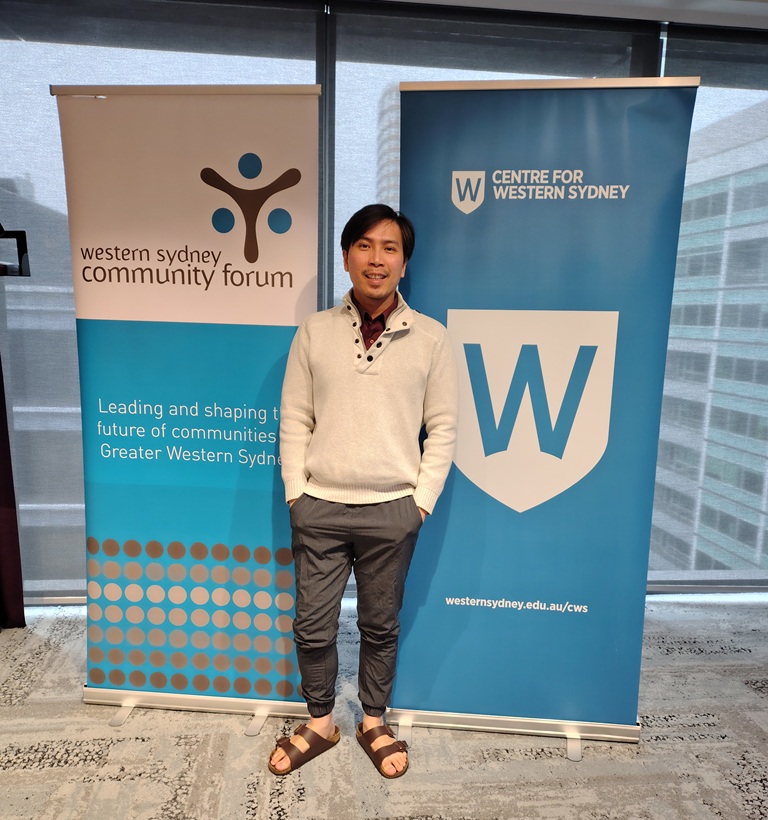
A kind TAFE teacher helped me to take this cool picture :P
So how does Carelogx fit into the grand scheme of the Symposium?
Throughout this symposium, one truth echoed across every region and every conversation — delivering quality aged care at home. Care plans, medication schedules, incident records, family communication & compliance documentation are the sheer the volume of information flowing around a single older person living independently is immense. And for frontline workers who are already stretched, the burden of capturing and communicating that information accurately and in real time has long been one of the sector's most underappreciated challenges.
This is precisely where purpose-built communication technology becomes not a luxury but a necessity. Platforms like Carelogix are designed with that reality in mind, embedding intelligent data capture directly into the point of care rather than leaving it as an afterthought to be completed at a desk at the end of a long shift. The Carelogix Note mobile application, allows frontline workers to document a home visit through voice recording, photography, location logging and file uploads — all from their own device, all while keeping their hands and attention on the person in front of them. A worker confirming medication administration, photographing the medication which allows review of the medication regime for proper management of polypharma, or noting a change in a client's environment does so in real time, building a chronological, traceable record that is automatically compiled into a report when the visit closes.
What makes this genuinely powerful in the context of place-based care is what happens to that data next. Through the Carelogix Nexus web application, care coordinators and organisational leaders gain immediate visibility into what is actually happening inside a client's home. Care plans can be refined based on real observations rather than anecdote. Trends can be identified early, before a situation escalates into a hospital admission. And when something does go wrong, there is a clear, objective and time-stamped record to support a fair and efficient response to meet the statutory requirements.
For a sector grappling with workforce pressure, compliance complexity and rising demand, this kind of integrated technology infrastructure gives time back to the people who need it most, the workers on the ground and the older Australians they are there to support. The village it takes to care for our elders needs good tools. Technology, thoughtfully applied, is one of them.

Worker cleaning the floor with an inadequate mop, consisting of a stick with only a few strings attached at the mop head The worker is unable to effectively clean the floor in timely manner with the current resources provided.

