
Building Bridges Network — March 2026 Recap: Trauma Informed Care
The March 2026 edition of the Building Bridges Network brought together disability support providers, allied health professionals, support workers, and sector leaders for a morning and afternoon packed with learning, connection, and hands-on demonstration. Held in Silverwater, the event covered the science and practice of trauma informed care, facilitated by clinical psychologist specialising in behaviour support Dr Mary Girgi and Moara Prado, General Manager at Golden Heart Services, supporting providers and teams understand behaviour as communication and translating this into practical, participant-centred supports.
Whether you attended on the day or are catching up now, this recap captures the key insights, conversations, and takeaways that made this event one of the standout sessions of the year.

Trauma Informed Care
The afternoon session opened with Moara and Dr Mary taking the floor. Both brought impressive credentials and lived professional experience to the room and together, they made for a compelling and deeply knowledgeable presenting duo
From the outset, they were clear about their purpose. "There are a lot of providers out there who claim to be delivering trauma informed practice," Moara noted, "and I think that can actually be quite damaging when you don't actually understand what trauma informed is." Too often, they observed, people conflate trauma informed care with simply avoiding all triggers — shielding participants from anything uncomfortable. The reality, they argued, is far more nuanced, and far more powerful.
trauma is an emotional or physical response to one or more harmful or life-threatening events or circumstances, with lasting adverse effects on your mental and physical wellbeing.
Defining Trauma
Dr Mary opened with a definition: trauma is "an emotional or physical response to one or more harmful or life-threatening events or circumstances, with lasting adverse effects on your mental and physical wellbeing."
But definitions only take you so far. The group unpacked the breadth of what trauma actually encompasses in practice — and the conversation became rich very quickly. There are well-known presentations like PTSD, which typically involves a singular, life-threatening event. Then there is complex trauma — a recognition that smaller events, accumulating over time, can be every bit as damaging. Complex trauma is not yet a recognised diagnosis in Australia's DSM framework, though it is formally acknowledged under the ICD used by much of the rest of the world. Dr Mary expressed hope that Australia would move in that direction.
And then there is intergenerational trauma. If a person is traumatised, they teach trauma responses to their children, who pass them on in turn. Moara spoke with passion about the displacement of self — the particular trauma of having to relocate, whether between suburbs, states, or countries. "People don't just get up and say, 'let's try something different,'" she said. "There's usually a reason behind it." When a child's sense of self and security is built through the people around them, and those people are uprooted, the impact runs deep. Working in the NDIS sector, she reminded the room, means regularly working with people who have been separated from everything that gave them their identity.
There was also a powerful moment in the discussion around what Bessel van der Kolk — a foundational voice in trauma research — once demonstrated in a presentation: that trauma is not always the event itself. It is the response that follows. The woman who was assaulted at 12 and never told her mother. That silence, that lack of support — that was the real trauma. It was a point that landed with visible weight in the room.

Vicarious Trauma and the Support Worker
Someone in the audience raised the issue of vicarious trauma — the cumulative toll that hearing and holding others' pain takes on carers, support workers, and allied health professionals. It was met with genuine recognition. "Working in NDIS, 100%, I can see everyone nodding," Moara said with a knowing smile. "If you're not nodding, it means you're new to the system. Welcome."
This thread wove its way through much of the afternoon. The sector asks support workers to show up with warmth, patience, and regulation — often in high-stress, under-resourced situations — and rarely provides adequate scaffolding for the toll this takes. The group agreed that emotional support for workers cannot be a one-off gesture; it needs to be systemic and regular.
Emotional support for workers cannot be a one-off gesture; it needs to be systemic and regular.
Common Trauma Responses
Dr Mary walked the group through the most common trauma responses: intrusive memories, nightmares, dissociation, physical symptoms (racing heart, sweating), avoidance, and hypervigilance. Each of these, she explained, is a rational nervous system response to an irrational experience. The problem arises when carers and support workers don't recognise these responses for what they are, and instead treat them as "challenging behaviours."
This misreading, the presenters argued, is one of the most harmful things that happens in disability support. When we respond to a trauma response with control, restriction, or escalation, we don't resolve the underlying distress — we compound it. "The trigger is a roadmap to what the pain is, the unmet need," Moara said. "If we're stopping to really sit down and analyse, what's the gap and how can we fill that in a safe and appropriate manner?"
One of the more illuminating discussions of the afternoon centred on compliance. It was raised that some participants — particularly people with intellectual disability — can appear entirely agreeable and easy to support. They say yes to everything. They follow every lead. But this compliance, far from being a positive sign, can be a significant concern. It may indicate that a person has never felt safe enough to assert a preference, has never had the opportunity to discover what they actually like, and is performing agreeableness out of anxiety rather than genuine engagement.
"You have to think about every little thing you say and how you say it," Moara reflected. "They don't even know what they like because they haven't had a chance to explore that. They haven't had the right support to sit down and feel safe where they can actually relax and be like, I'm not going to get in trouble."
The solution, the presenters suggested, is giving genuine choices — not open-ended questions that default to yes, but structured options. "Do you want to do A or do you want to do B?" rather than "Do you want to do this?" It's a small shift in language with significant implications for autonomy and trust-building.
The SEAL Test and Practical Frameworks
Moara shared a practical decision-making tool she uses in her work — the SEAL test. Before any action or communication, ask: is it Safe? Is it Effective? Is it Appropriate? Is it Lawful?
"As a support worker," she explained, "I'm not a psychologist, I'm not an ambulance, I'm not a doctor. So is it lawful for me to be giving this advice?" Running any decision or statement through these four filters, she argued, keeps workers operating within their scope while still being genuinely responsive and helpful. It's a deceptively simple tool that can prevent a lot of harm.
The group also worked through a practical scenario — supporting a participant named Alex who raises his voice or refuses help — and explored what a trauma informed response would look like. The conversation was lively and honest. People brought their own experiences to the table.
Key communication principles that emerged included:
Validate the emotion, not the behaviour. "I can see you're really frustrated" is different from endorsing throwing something.
Offer options, not open questions. "Would a glass of water help? Should we go for a walk? Would you like me to leave you alone?" rather than "What do you need?" — which can overwhelm someone already dysregulated.
Mirror physical cues back carefully. "I notice you're pacing. When I pace, it usually means I'm frustrated. Is that how you feel?" This helps people with limited emotional vocabulary to identify and name what they're experiencing — without projecting or assuming.
Avoid "I understand." It was highlighted that this phrase, meant with genuine empathy, can be deeply triggering for people with significant trauma histories. You haven't walked in their shoes. Alternatives like "I hear you" or "That sounds really hard" tend to land much better.
Check your own emotional state first. "Emotions are contagious," Dr Mary noted. "If you're coming into a situation stressed and afraid, you're going to pass that on." Even a slow breath before entering a difficult situation can shift the dynamic.
When Trauma Informed Care Goes Wrong
Perhaps the most confronting part of the session was the discussion around re-traumatisation — what happens when services and support workers fail to apply these principles. The group identified several patterns: misinterpreting trauma responses as wilful behaviour, over-relying on control and compliance, stepping in too early and denying participants the chance to try, fail, and learn. The result is a loss of trust in services, a loss of autonomy, and often a cycle of moving from provider to provider as each relationship breaks down under the same unaddressed patterns.
"Failure is essential to learning," Moara said plainly. "You have to fail to learn."
There was also a sober reckoning with the reality of inconsistent care. Support workers work alone, but their actions are cumulative. "Every single thing that you do on your shift impacts the person before you and after you," Moara said. "If everybody's giving the right support, everyone's putting in the right boundaries, then that person has a village — because it takes a village." When that village is fractured, the person who suffers most is the participant — someone who may already have spent a lifetime learning that connection is temporary and that people leave.

Boundaries, Attachment, and the Hardest Conversations
One of the most emotionally resonant conversations of the afternoon came near the end. An attendee shared their experience watching a friend with a disability repeatedly grieve the loss of support workers who left — misinterpreting professional relationships as friendships, unable to understand why someone who was warm and present for months would suddenly stop responding to messages.
This drew a candid and caring response from both presenters. Boundaries, they emphasised, are not about being cold. They are about honesty. It is possible — and necessary — to say to a participant: I do care about you, but we are not friends. And this is why. Not as a rejection, but as a clarity that protects both parties and prevents a particular kind of harm that the sector rarely talks about openly.
"You're not going to be their support worker for the next 25 years," Moara said. "So although awkward, these conversations are very important to maintain." The suggestion was practical: set expectations at intake, build it into service agreements, make it a structural norm rather than a personal judgment call in the moment. That way, the burden doesn't fall entirely on an individual support worker's ability to navigate it in the field. A worker can simply refer back to what was agreed at the start: "Do you remember when you met my boss and she explained that I can't do this, or speak to you outside my shift?" That externalises the limit in a way that protects the relationship rather than damaging it.
"You don't rise to your support," she added, echoing a phrase she clearly holds close. "You fall to your level of training."
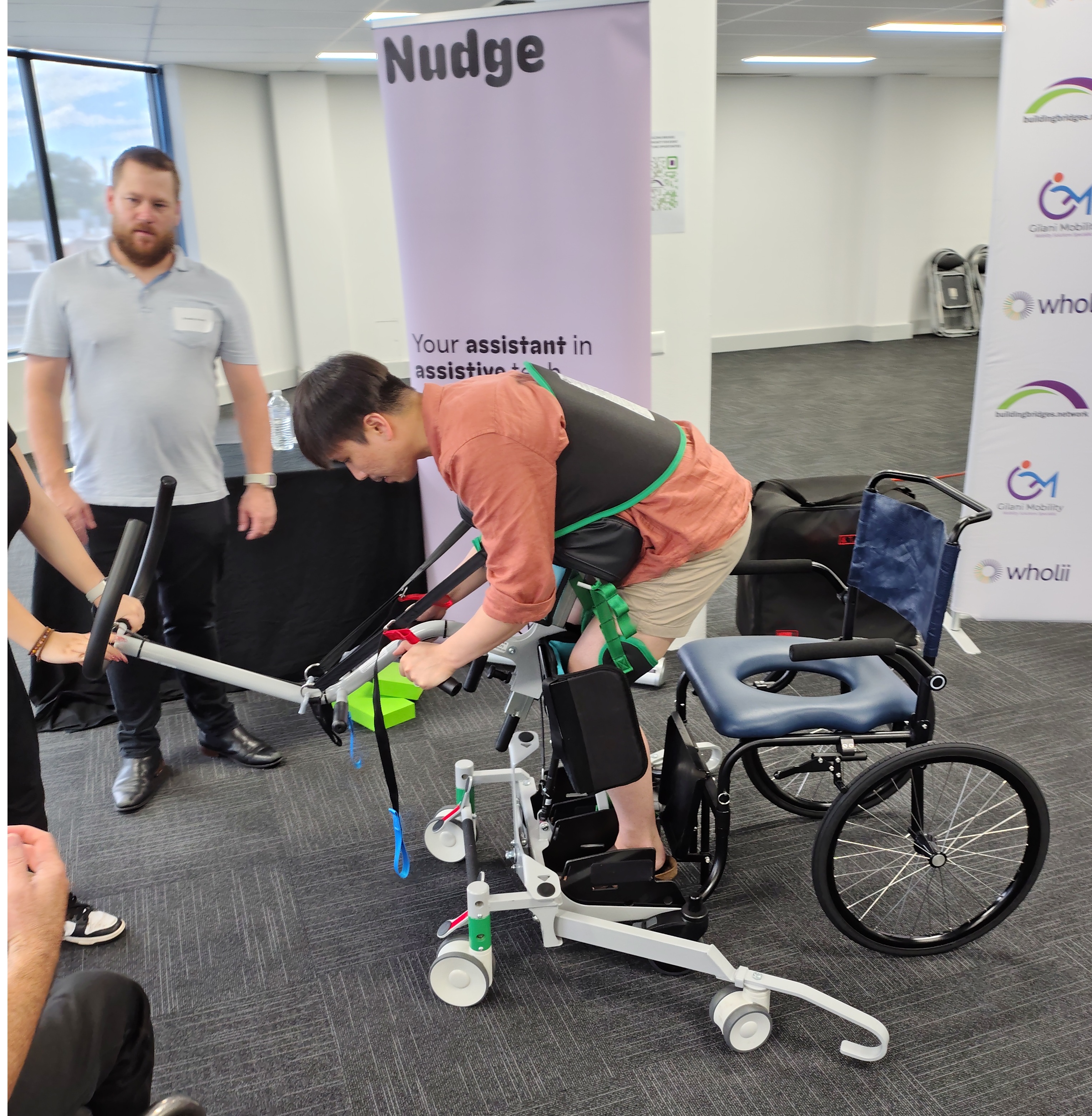
Eamon’s live demonstration of Nudge Assistive Technologies

Reimagining Transfers
The morning session offered a very different kind of energy — kinaesthetic, hands-on, and at times delightfully playful. Eamon Wood, Director of Nudge Assist, who covers the greater Sydney area as a specialist in assistive technology, brought a piece of equipment that immediately drew curiosity from the room: a mechanical standing and transfer aid that uses leverage and physics to lift and reposition a seated participant safely and efficiently — requiring only one support worker instead of the conventional two.
The device works through a combination of a padded chest support, adjustable knee blocks, a back brace strap, and optional thigh straps, together forming a secure harness-like structure around the participant. Once fitted, a support worker can lift, transfer, and lower the participant smoothly without the biomechanical strain typically associated with manual transfers.
Eamon Wood didn't just talk about the equipment — he put it to work in real time, with willing participants from the audience stepping up (quite literally) to experience it firsthand. What followed was an engaging, good-humoured sequence of fittings, lifts, and coached trials that gave attendees a genuine feel for both the device and the technique.
Key fitting notes from the demonstration included:
Getting the knee blocks as close as possible to the participant's knees is critical to stability during the lift.
The back brace strap needs to be firm, but tolerance varies between individuals — some can manage it tight, others find it uncomfortable.
Thigh straps are optional but useful, particularly when establishing the fit for the first time. When thigh straps are in use, the back brace doesn't need to be cinched quite as high.
The chest pad should sit firmly against the participant's stomach, with enough padding to distribute pressure comfortably.
Always double-check that no wheelchair lap belt, commode strap, or other restraint is in place before initiating a lift.

The lift itself is a single, fluid movement — initiated with a count and driven by the support worker walking backward in a controlled arc, using their body weight and leverage rather than raw muscular effort. The knee blocks push the participant's knees forward during the lift, which in turn repositions them securely into the seat during the lowering phase. Eamon emphasised pace: "You don't want to go too slow because you'll lose momentum and start fighting gravity. But you also don't want to rush it. Find the speed the client is comfortable with."
"I always say to the client that the optimal lift we get is usually around the third time," Eamon noted. "The first time you're getting used to it, I'm getting used to lifting you. By the third lift, everyone's got it in place."
One Worker Instead of Two
The headline feature of the device — and the one that generated the most discussion — is its ability to facilitate a safe transfer with a single support worker. Conventional manual handling guidelines in aged and disability care typically require two workers for transfers involving non-ambulatory participants. This places significant operational pressure on providers, requires precise rostering coordination, and can delay or restrict a participant's mobility during their day.
By using physics to redistribute the effort, this device changes that equation. One worker, properly trained and with the right setup, can safely manage the entire transfer — including from wheelchair to commode, commode back to wheelchair, or any number of common repositioning scenarios.
Crucially, because nothing passes beneath the participant during the lift, the device is also compatible with situations involving wound care, hygiene needs, or pressure injury management — areas where traditional sling hoists can create complications. The absence of a sling beneath the participant means better access for personal care, dressing, and skin checks without requiring additional repositioning.

Training and Safety
Eamon was clear that the device is not a plug-and-play solution. Proper training is essential and reinforcing that staff need to be formally instructed before using the equipment with participants. The setup is straightforward once learned — walk up, apply the back wrap, tighten, decide whether to use the thigh strap — but the consequences of a poorly executed lift are real, and the investment in training protects both the worker and the participant.
For providers looking to introduce the technology, Eamon's advice was to begin slowly, use the thigh straps initially as an added safeguard, and always capture photos or notes during the training run-throughs so workers have a reference to return to.
He also travels across all of Sydney to support providers with fitting and training, and encouraged anyone interested in trialling the equipment for their team to get in touch directly.
Vital for the Sector
For NDIS providers managing rostering complexity, worker health and safety obligations, and tightly constrained support hours, a single-worker transfer solution is not just a convenience — it is potentially transformative. Back injuries remain one of the most common and costly occupational health issues for support workers in residential and in-home care settings. Technology that reduces this risk while simultaneously increasing participant independence and flexibility in scheduling is exactly the kind of innovation the sector needs more of.
Beyond the mechanics, there is something quietly significant about a participant being able to be lifted, repositioned, and supported without needing two people to be present and coordinated. It preserves dignity. It reduces wait times. And it creates more moments of normalcy within a day that can otherwise feel heavily supervised and scheduled.
A Sector Learning Together
What made March's Building Bridges Network session so memorable was not just the quality of the content — though that was genuinely excellent — but the quality of the conversation it generated. Attendees were engaged, honest, and generous with their own experiences and questions. There were no easy answers offered, and none were expected.
The through-line between the morning's assistive technology demonstration and the afternoon's trauma informed care session was perhaps more apparent than it first seemed. Both were about the same thing at their core: seeing a person in their full humanity, understanding what they actually need, and designing support around that — not around what is operationally convenient, or what has always been done.
Dr Mary's closing note lingered in the room: that all of this — the communication strategies, the boundary work, the emotional attunement — is ultimately just basic human interaction, done with care and intention. "Be genuinely interested in who you're talking to," she said. "Across the board, you may end up with better outcomes naturally."
It sounds simple. In practice, in a demanding, under-resourced sector working with some of the most vulnerable people in the community, it is anything but. That's precisely why events like this one matter.
What's Next
Building Bridges Network runs monthly, and the feedback on the day was clear: there is appetite for more. Topics suggested by attendees included further sessions on Positive Behaviour Support, NDIS plan management, safeguarding practice, and trauma-specific clinical frameworks. If you have a topic you'd like to see addressed at a future session — or if you would like to present — please reach out to the organising team.
Dr Mary also extended an open offer on the day: her team provides free mock-up practice training for providers and their teams, covering how to identify unmet needs and how to respond to them effectively. If that's something your organisation would benefit from, please make contact.
A special thank you to Dr Mary, Moara, and Eamon for giving so generously of their time and expertise. And to everyone who attended, asked a question, offered a perspective, or volunteered to be lifted in front of their colleagues — you made the room what it was. Least by not last, Earl Schonberg (ConnectCare), Emanuel Gini (AbilityConnect), Howard Law (Global Rehabilitation Service) and the entire team behind Building Bridges Network
See you next month.
Related Articles

NDIS Building Bridges Network Apr 2026
The April 30 edition of Building Bridges left attendees with something more valuable than a stack of brochures and a pocketful of business cards. It left them with a renewed sense of what is possible when the right people are in the same room.

NDIS Building Bridges Network Feb 2026
Building Bridges has always positioned itself as a platform to connect, educate, and empower those working in and around the disability sector.

NDIS Building Bridges Network Jan 2025
The I-CAN tool has been trialled and endorsed by the Centre for Ability for approximately two years, but it has never been piloted under the NDIS itself — a fact that understandably has the sector on edge.